Outdoor Sports People Talk About Safety Far More Than Thrills
Nov 18, 2026 - 1 minute read
Ask someone who has never clipped into a ski binding why people throw themselves down mountains, off cliffs and into cold water, and you will get one word back: adrenaline. The outdoor sports crowd is supposed to be the thrill-seeking crowd.
We read what that crowd writes when it talks to itself. Across nine outdoor sports, of the 723 Reddit posts and comments that state a motivation, 41% are about safety and managing risk. Adventure and thrill-seeking shows up in 12%. It ranks sixth, just behind convenience.
How we looked
Kimola is an AI platform that turns customer feedback into enterprise-grade market research. For this study the feedback is Reddit posts and comments, and the questions were who does these sports, why, and what stops the people who want to but don't. We searched for threads about nine sports (scuba diving, mountain biking, camping, kayaking and rafting, skiing and snowboarding, surfing, climbing, paragliding and sailing), pairing each sport's name with phrases like "why I chose," "why I love," "dangers" and "why I don't like." Choosing threads that discuss a sport in both a good and a bad light was deliberate: we wanted every point of view in the room.
From those subreddits, 15 in total, we kept only conversations from the past year. Replies too short to say anything were dropped, posts where people describe their own experience were favored, and the share any single thread could contribute to a sport was capped. Popular sports produce far more chatter than niche ones, so every sport was trimmed to the size of the smallest. That leaves 112 posts and comments per sport and 1,008 in all, 86% of them comments. It is one platform, and mostly English speakers.
Kimola read each one through its Dimensions, a set of lenses that each ask a different question of the same text: why did this person do it, what went wrong, what did they wish they had, who is talking.
The first thing on their minds is not getting hurt
Motivations is the Dimension that asks why people do what they do, and the answers here are sober ones. After safety comes skill development and learning at 17%. Relaxation and mental well-being, confidence and reassurance, and convenience each sit at 13%, all a nose ahead of thrill.
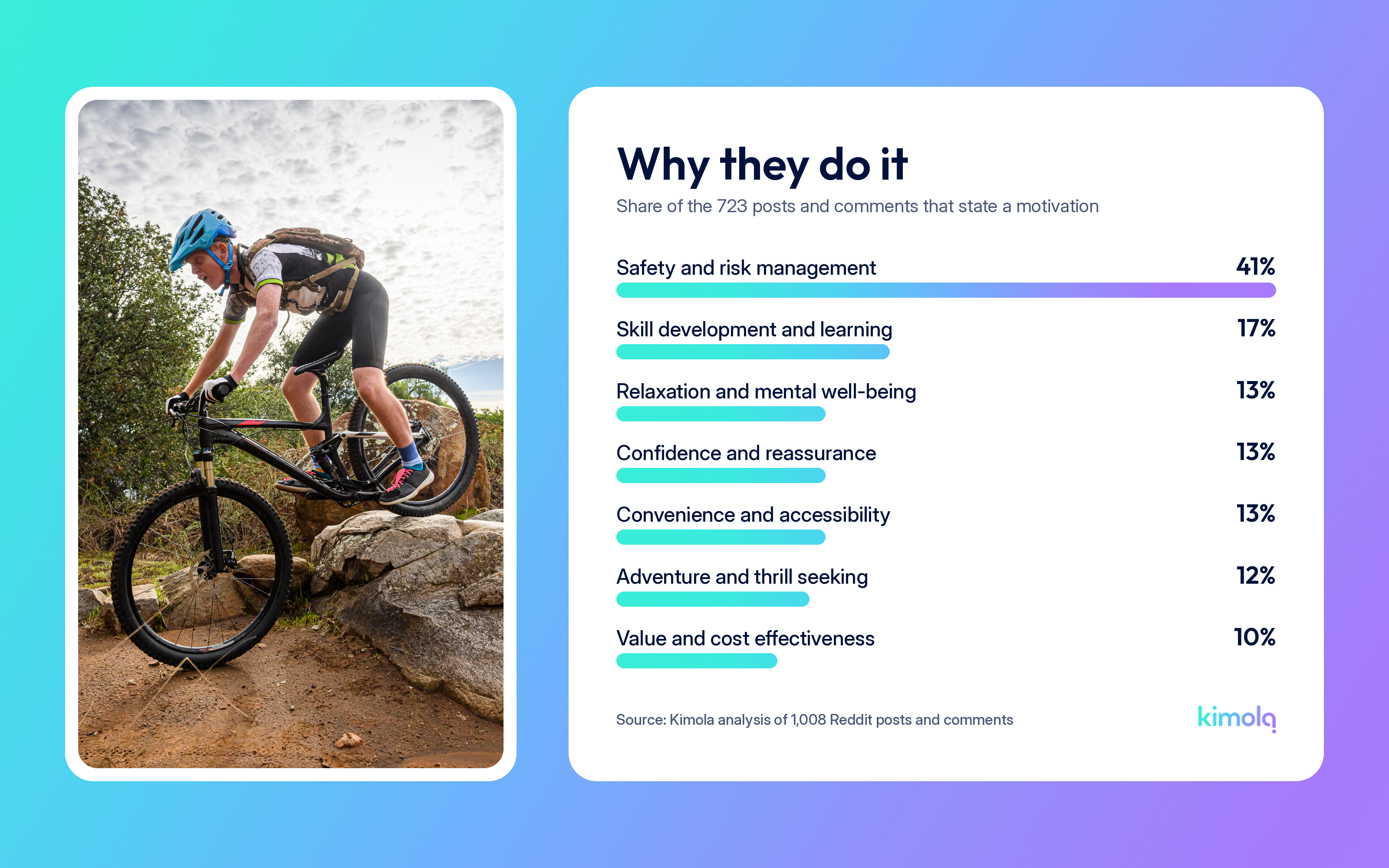
Safety here does not mean timidity. The way divers put it, it means refresher courses, fins that fit, a buddy who communicates and the willingness to abort a dive that feels wrong. The picture is of people who want to get good at something difficult and come home in one piece.
The same mood shows in Pain Points, the Dimension that asks what hurts. Of the 601 posts and comments that describe a problem, the largest share, 31%, is about emotional impact and anxiety, ahead of bad conditions at 21% and skill gaps at 16%. The most common problem in outdoor sports, by this count, is the feeling in your stomach.
The thrill-seekers exist, and they are airborne
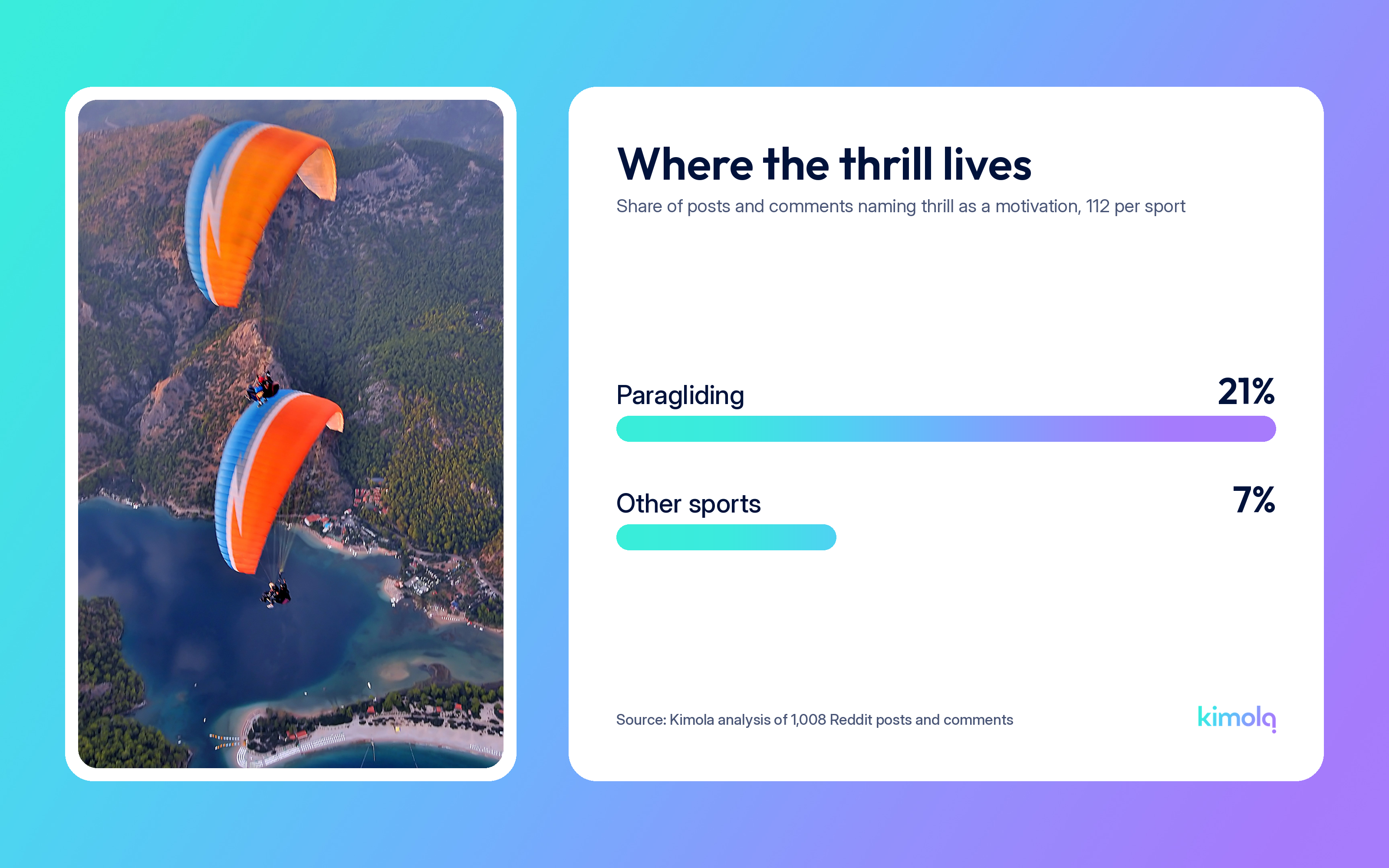
So where did the adrenaline go? Kimola tests every combination of sport and label to see where one group stands apart from the rest, a feature called Signals, and it ran 1,410 such tests on this data. It found the thrill-seekers in one place. In the paragliding threads, 21% of posts and comments name adventure and thrill-seeking as a motivation, against 7% in the other sports. That is close to three times the rate.
It is relative: if asked “how many years of life expectancy would you be willing to trade in for a life filled with paragliding” my answer would not be “zero”. We all made that choice.
They are happy about it, too. Of the paragliding posts that talk about thrill, 12% are negative, against 34% of paragliding posts overall.
Pilots also bring up convenience and accessibility more than the rest, at 19% against 7% elsewhere, and the reason is the sky itself. Paragliding waits on weather, and students write about courses strung out over weeks. The sport that talks most about thrill is also the one writing about waiting for the wind.
Beginners are not one crowd
Personas is the Dimension that asks who is talking, and 364 posts and comments give enough away to say. Kimola can cross one Dimension with another in Tables, and crossing Personas with Motivations shows that the safety-first mindset belongs mostly to divers. Among anxious, safety-focused divers, 73% name safety as a motivation. Among novice recreational divers it is 66%.
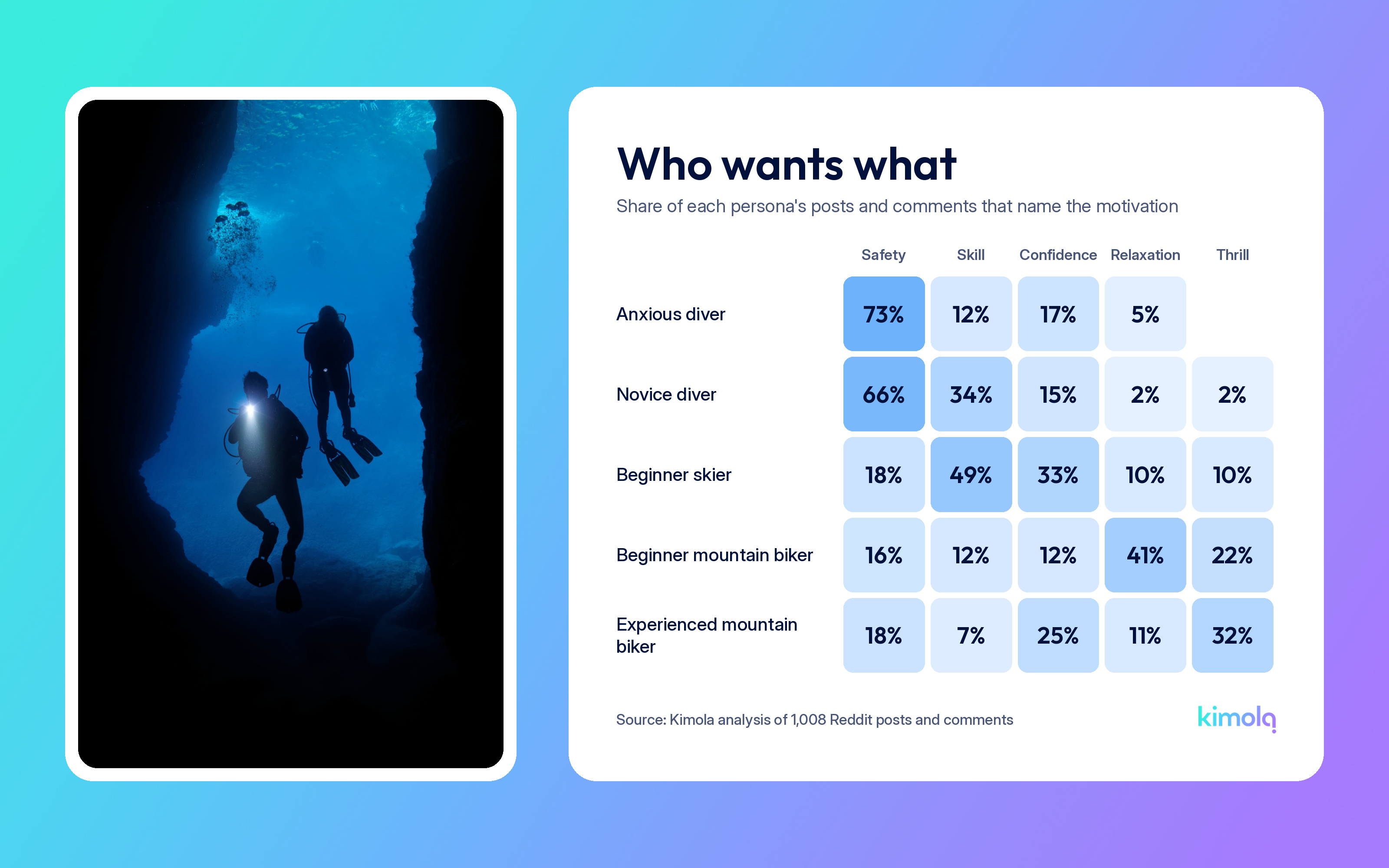
Beginners elsewhere are after other things. For beginner skiers the top motivation is skill development and learning, at 49%, with safety at 18%. Mountain biking beginners lead with relaxation and mental well-being, at 41%, and safety comes in at 16%. One group is learning a technique. The other is clearing its head.
Experienced mountain bikers are the closest thing to the stereotype outside the paragliding threads: 39% talk about performance and 32% about thrill. These are small groups, between 28 and 41 posts and comments each, and in this data personas turn up mostly in diving, mountain biking, skiing and paddling. Treat them as sketches.
What stops them is the place and the nerves, rarely the price
Underlying Causes is the Dimension that asks what sits behind a problem, and 732 posts and comments point to one. Two causes lead, and neither is money: price-driven tradeoffs come up in 5% of all posts and comments.
Environmental and site conditions come up in 24% of all posts and comments, psychological and emotional factors in 23% and inexperience in 18%.
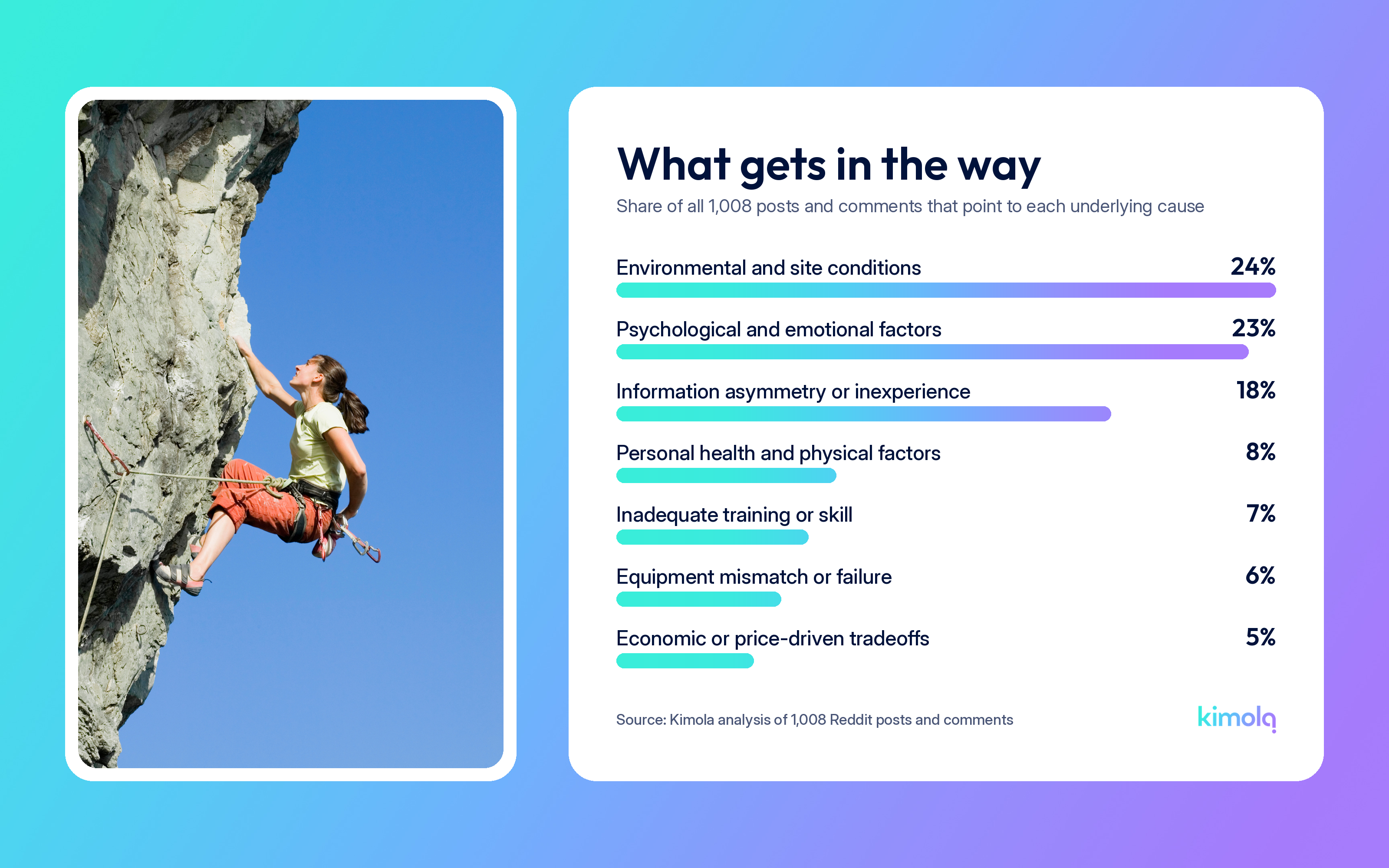
Climbers are the clearest case of the first. In the climbing threads, 45% of posts and comments cite environmental and site conditions, against 18% in the other sports, and many describe the move from an indoor wall to real rock. Indoors, a grade is a promise. Outdoors it is a suggestion, and the suggestion is cold. One first-timer reports that "there’s a big difference between indoor and outdoor grades!"
Campers are the clearest case of the second. In the camping threads, 35% describe going solo, against 5% in the other sports, and 34% of those solo posts also carry the anxiety pain point. The day is lovely. The night is when, as one camper notes, "rustling wildlife always sounds way bigger in the dark!"
I've been solo camping many times and I still get scared sometimes. But I always end the trip very proud of myself and I have such a good time...when the sun is out lol.
One caution on camping: its posts and comments come from a handful of threads, one of them about a first night camping alone. Read it as a close look at those conversations.
What they want is a teacher
Unmet Needs is the Dimension that asks what people wish they had. Of the 438 posts and comments that name one, 36% ask for targeted educational resources and 25% for personalized guidance and supervision. Gear that fits and works follows at 18%.
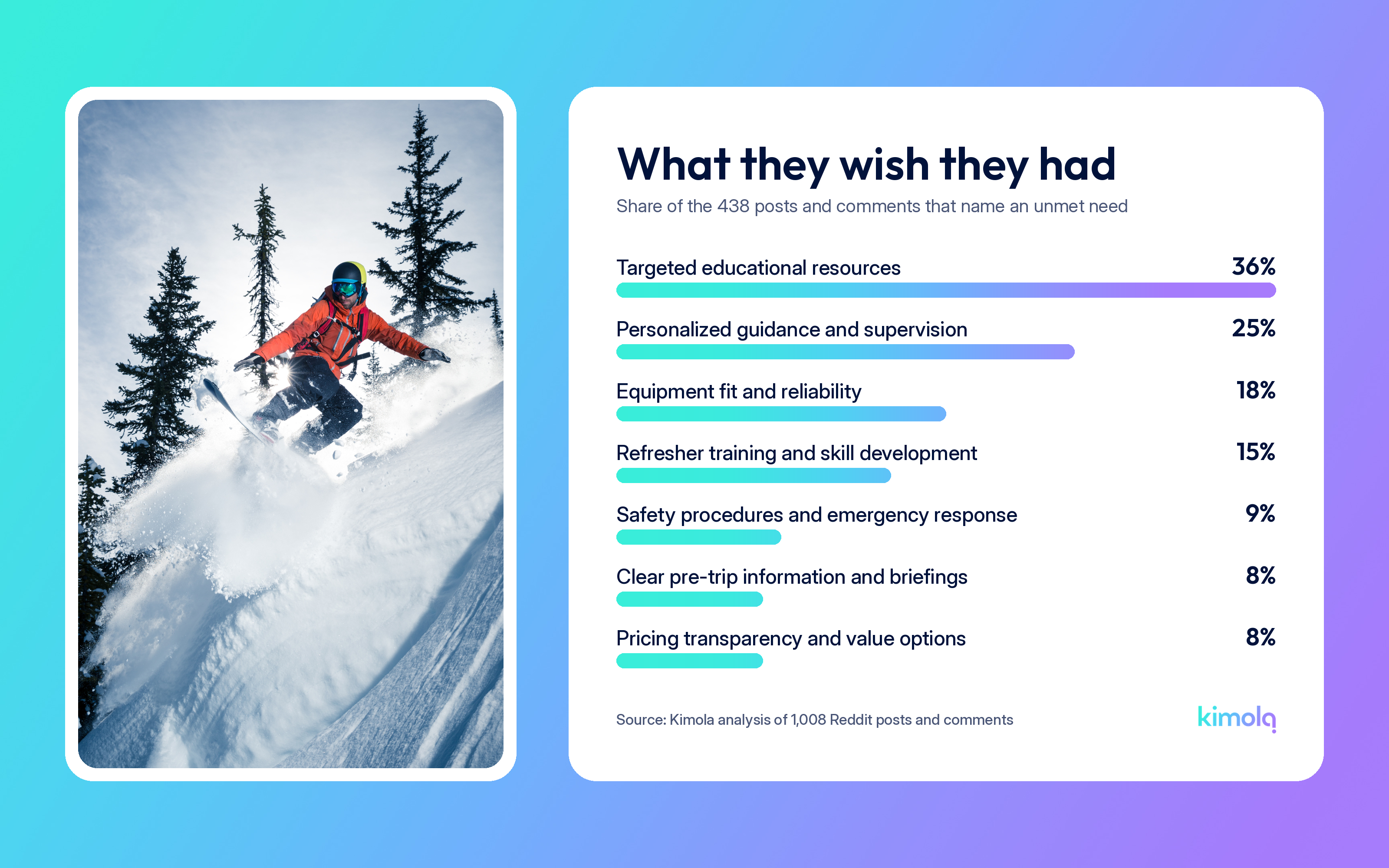
Novice divers ask loudest: 46% of their posts and comments want personalized guidance and supervision, and they describe certification courses that moved faster than their confidence did. Among beginner skiers the figure is 33%. "Lessons. Don’t expect to enjoy it without them," writes one who started out hating the sport.
This is the other half of the safety finding. People want to be safe, write a lot about being afraid, and keep arriving at the same fix: someone to show them how.
The sensible adventurers
Read together, the nine sports tell one story. Safety leads the motivations, anxiety leads the pain points and teaching leads the unmet needs. Thrill is real but lives mostly in the air, the safety-first mindset is strongest underwater, and beginners in each sport arrive wanting something different. The adrenaline junkie is in there somewhere, probably checking the wind forecast.
Nobody asked these people a survey question. They wrote what was on their minds, and the same lenses work on anything people write unprompted: app store reviews, support tickets, open-ended survey answers. A company selling ski lessons, dive courses or tents would find its own version of this story in its own feedback. To try it on yours, create a Kimola account.